Revisiting Multi-View Stereo: A Sequence-to-Sequence Formulation

NeurIPS 2026

CVLab, EPFL, Switzerland

Abstract

Computing accurate geometry from multi-view images is a fundamental problem in computer vision. Recent feed-forward (FF) models jointly estimate 3D geometry and camera parameters, but they typically suffer from geometry distortion caused by reconstruction ambiguity, even when ground-truth camera parameters are supplied. In this paper, we study the multi-view stereo (MVS) problem with known camera parameters and propose a novel approach that bridges conventional MVS and FF methods. Rather than casting MVS as a sequence-to-one mapping that predicts depth only for a single reference view, we reformulate it as a sequence-to-sequence task, akin to FF models, that jointly predicts geometry for all input views. We introduce a global transformer-based architecture with two components that explicitly exploit camera-induced priors: ray-map embeddings that inject camera parameters into image patch tokens, making the transformer camera-aware, and a unified global cost volume that replaces conventional per-view cost volumes to jointly capture 3D structure across all views. Extensive experiments on multiple public benchmarks show our approach achieves state-of-the-art performance, surpassing both MVS and FF reconstruction baselines.
Video

Sequence-to-Sequence Formulation

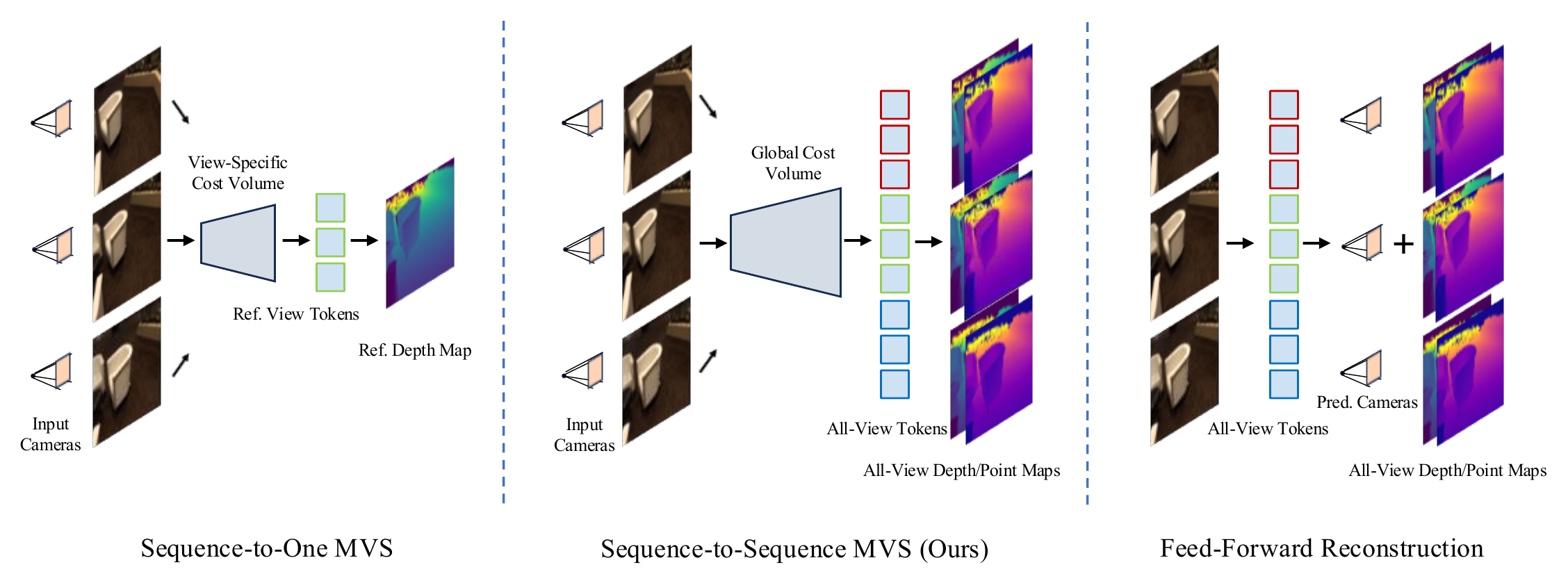
Sequence-to-one MVS, sequence-to-sequence MVS and feed-forward reconstruction.

Conventional MVS methods follow a sequence-to-one formulation: a view-specific cost volume is built for a single reference view, and only its depth map is predicted. Feed-forward reconstruction models jointly predict geometry for all views, but also have to estimate the cameras, which leads to geometry distortion caused by reconstruction ambiguity. S2S-MVS bridges the two: it adopts a sequence-to-sequence formulation that predicts depth and point maps for all input views at once, while conditioning on known cameras through a single global cost volume.

Framework Overview

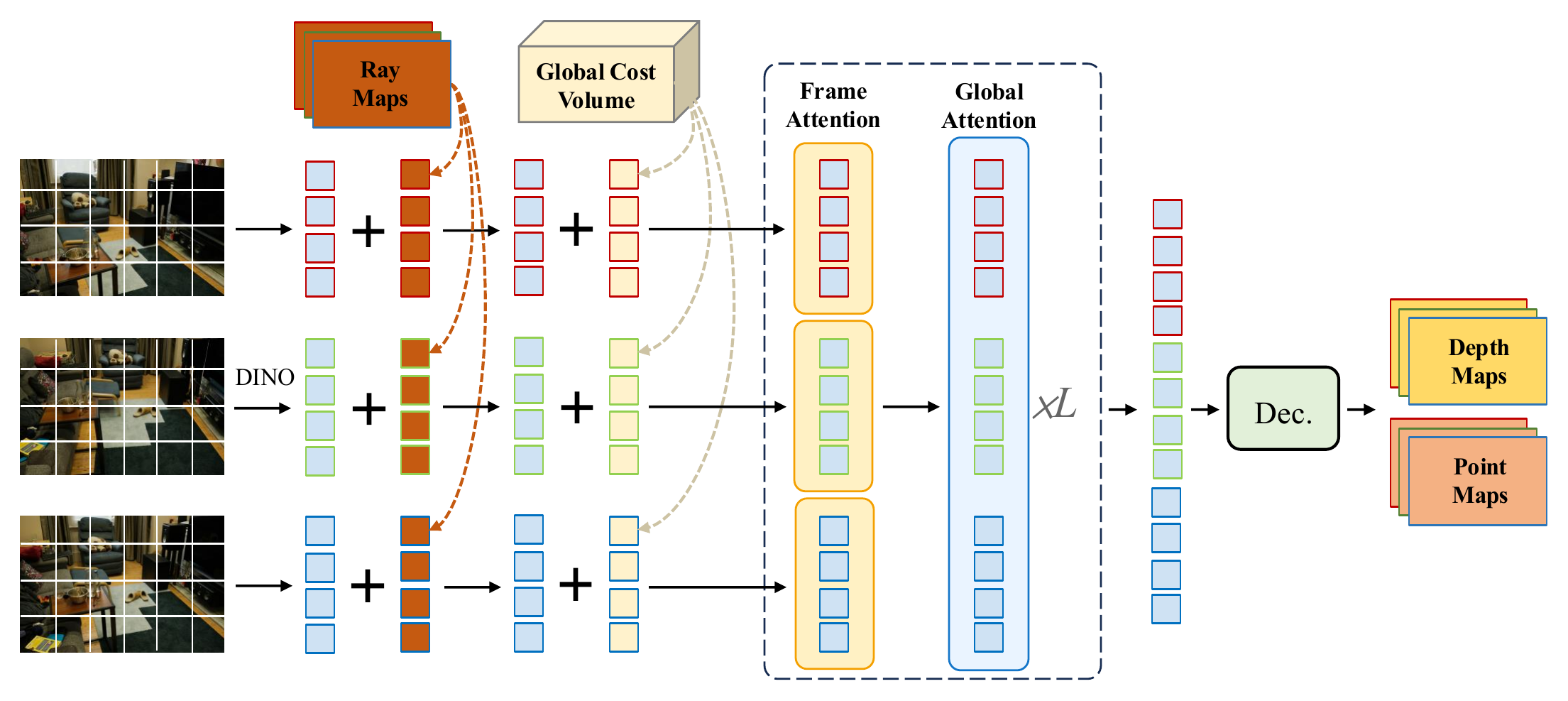
S2S-MVS Framework.

For each input view, we extract view tokens with a DINOv2 backbone and incorporate two camera-induced priors: Ray-map embeddings transform camera intrinsics and extrinsics into ray maps that are tokenized and merged with the image tokens, making the transformer camera-aware. Global-cost-volume embeddings replace the conventional per-view cost volumes with a unified cost volume that captures the 3D structure of the scene across all views. The tokens are then processed by attention layers that aggregate frame-level and global information, and decoding heads produce the depth maps and point maps of every input view.


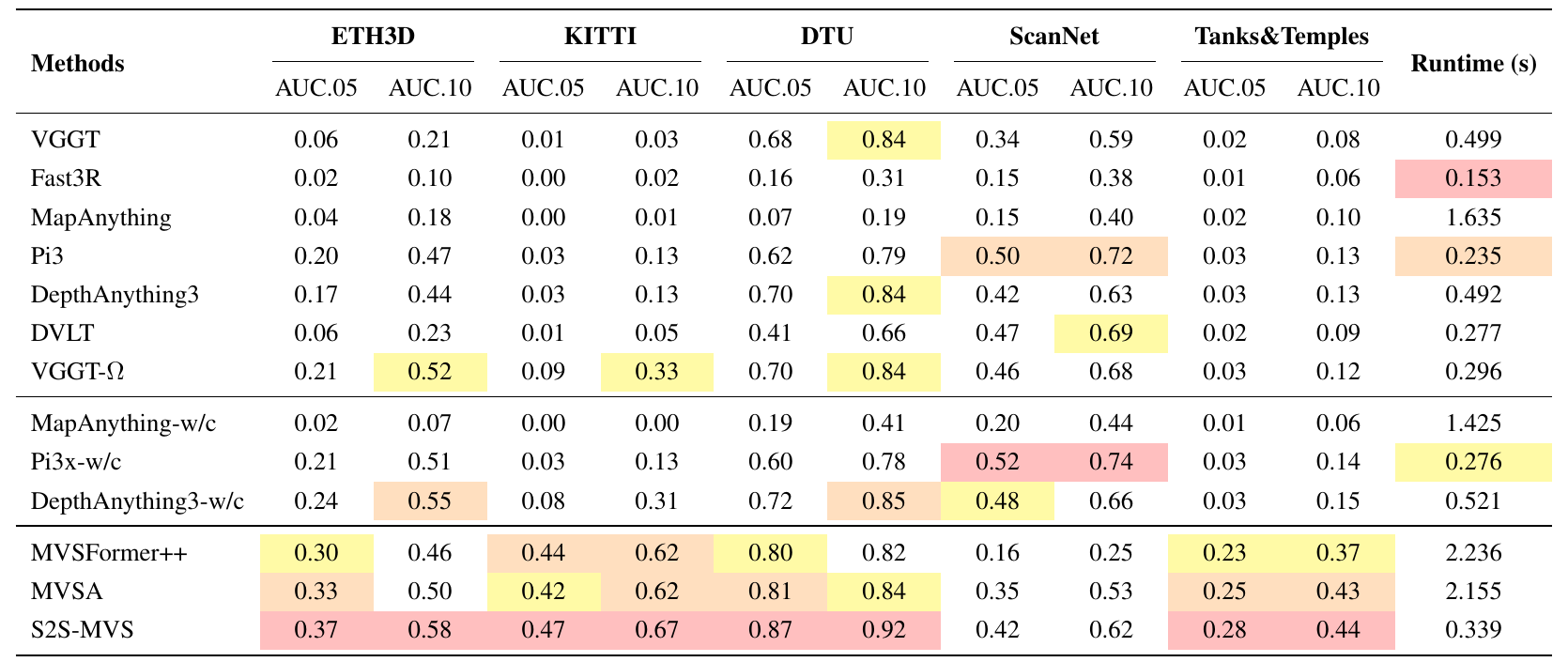
Quantitative comparison on the RMVDB benchmark

Quantitative comparison on the RMVDB benchmark.

We compare S2S-MVS with sequence-to-sequence feed-forward models (with and without ground-truth cameras, marked -w/c) and sequence-to-one MVS methods. The best, second-best and third-best results are highlighted. S2S-MVS obtains the highest AUC on ETH3D, KITTI, DTU and Tanks&Temples, and is considerably faster than the MVS baselines MVSFormer++ and MVSA.


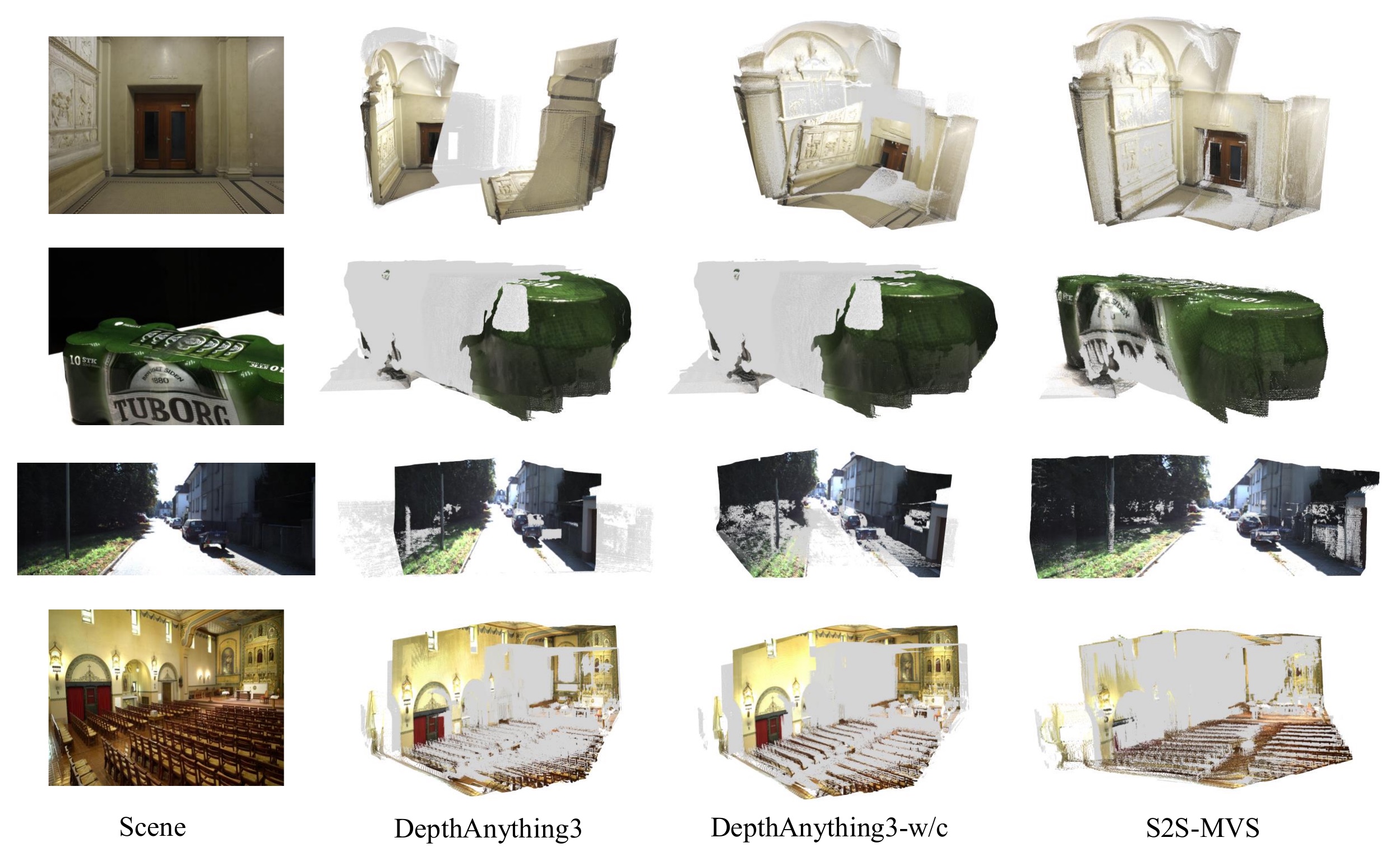
Qualitative comparison of point map prediction

Qualitative comparison against DepthAnything3.

Predicted point maps are overlaid with the gray-coded ground truth to highlight alignment accuracy. DepthAnything3, with or without ground-truth cameras, suffers from 3D anisotropic scale distortion (e.g. on the Tanks&Temples scene in the last row), while S2S-MVS does not.


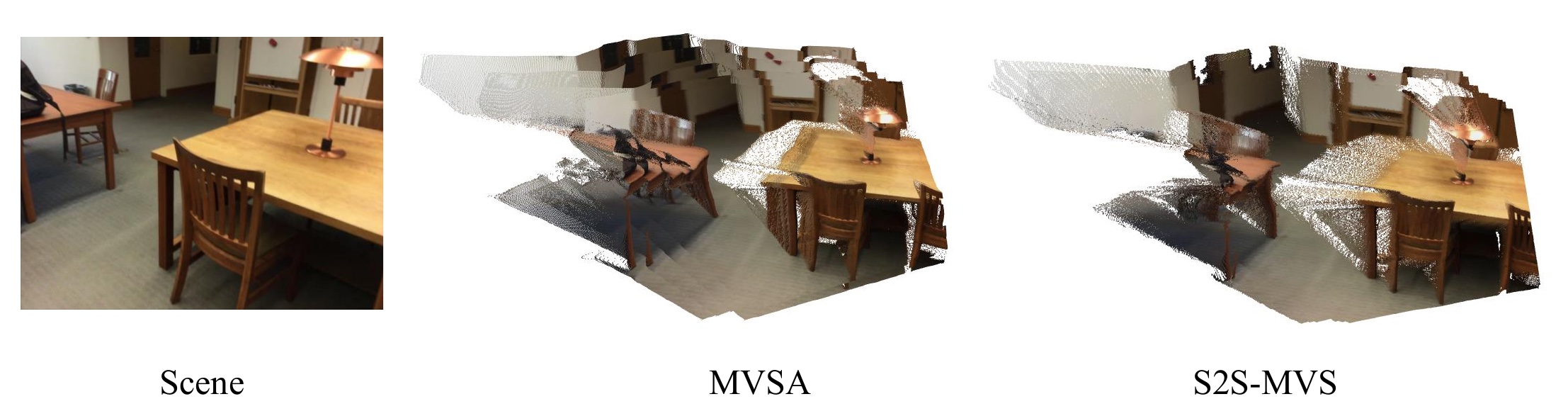
Global alignment compared to sequence-to-one MVS

Comparison of global alignment against MVSA.

Sequence-to-one methods like MVSA reconstruct each view independently, which can lead to misalignment across views. By reasoning about all views jointly, S2S-MVS produces globally consistent reconstructions.


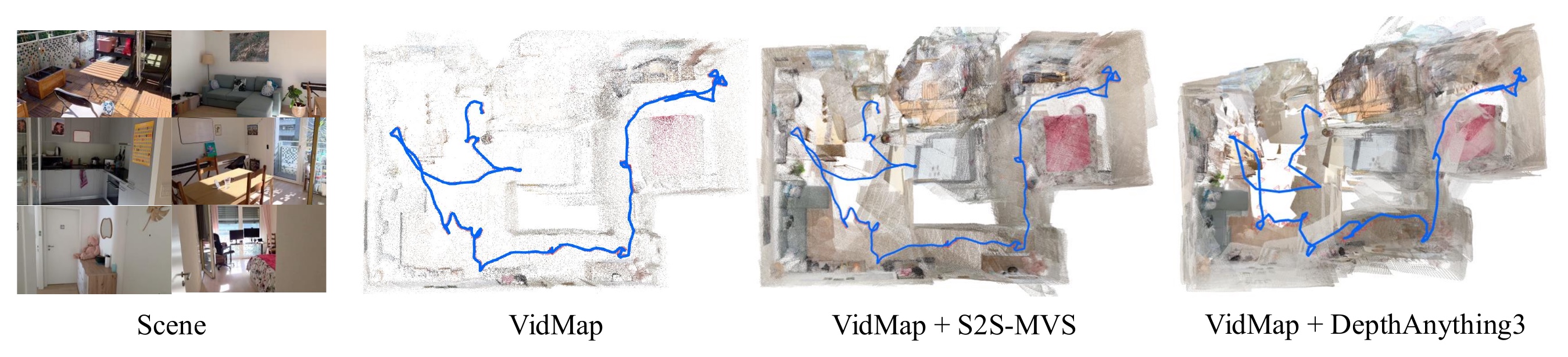
Dense video reconstruction combined with SfM

Dense video-based reconstruction results.

Using camera parameters estimated by VidMap from video frames, S2S-MVS produces accurate dense reconstructions, whereas DepthAnything3 creates misaligned point clouds and camera offsets.

BibTeX

@inproceedings{fan2026s2smvs,
      author    = {Fan, Aoxiang and Dumery, Corentin and Talabot, Nicolas and Fua, Pascal},
      title     = {Revisiting Multi-View Stereo: A Sequence-to-Sequence Formulation},
      booktitle = {Advances in Neural Information Processing Systems (NeurIPS)},
      year      = {2026}
}